Kidney Stones Are Not What You Think: UCLA Discovers Live Bacteria Inside
A landmark UCLA study published in PNAS reveals that calcium oxalate kidney stones contain live bacterial biofilms entombed within their mineral layers, overturning decades of medical understanding and opening new treatment frontiers.

- 6 min read
If you asked any urologist five years ago what a kidney stone was made of, the answer would have been simple: mineral buildup. Calcium and oxalate supersaturate in the urine, crystals form, and over time those crystals aggregate into a stone. The treatment playbook followed the same logic. Shatter the stone with shock waves, flush the fragments, tell the patient to drink more water.
That entire framework just collapsed.
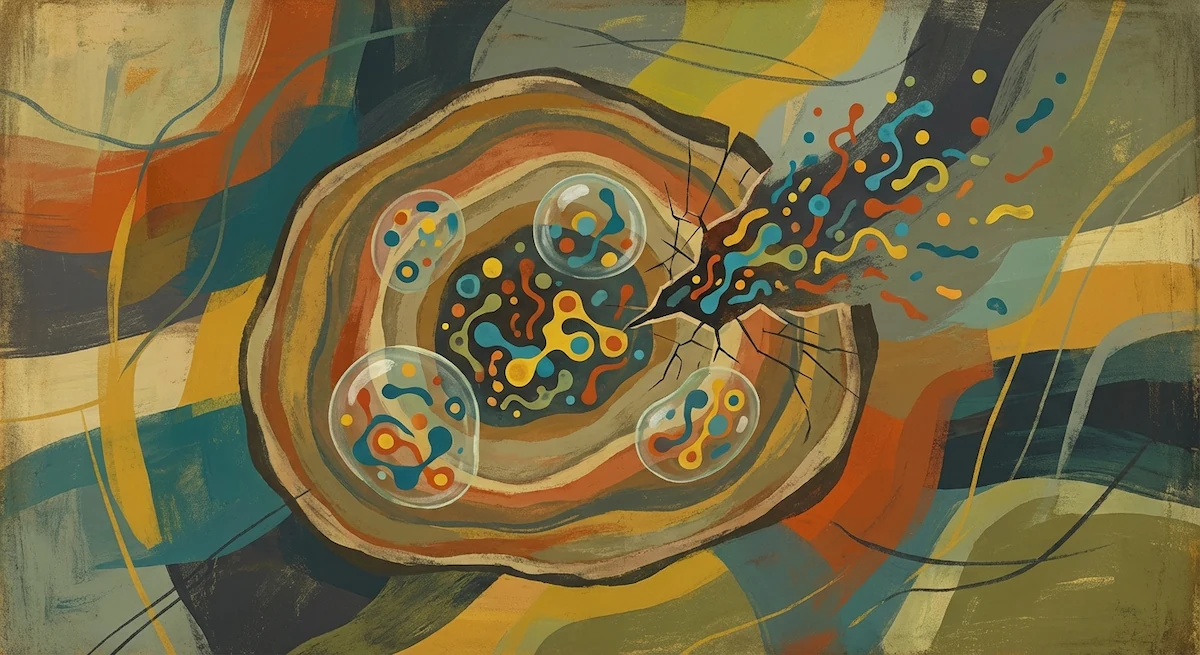
A January 2026 study in the Proceedings of the National Academy of Sciences (PNAS), led by a research team at UCLA, has shown that calcium oxalate kidney stones, the type responsible for roughly 80% of all cases, harbor living bacterial communities and fungal-like biofilms sealed within their mineral structure. These stones are layered biocomposites: alternating sheets of crystallized mineral and active microbial life, with the bacteria serving as the biological scaffold around which the stone assembles itself.
The implications cut across every aspect of kidney stone medicine. Why stones form in the first place. Why they come back so reliably. Why a routine procedure like lithotripsy can occasionally trigger life-threatening sepsis in patients whose urine tested perfectly clean.
What the UCLA Team Found
Using fluorescence microscopy and scanning electron microscopy, the research team led by Professor Gerard C.L. Wong at UCLA examined kidney stones removed from human patients during surgical procedures. Bacterial biofilms were intercalated, layered between polycrystalline mineral sheets, throughout the interior of the stones.
This was not surface contamination. These were living microbial communities structurally integrated into the stone itself, acting as biological scaffolding (a nidus) that allows mineral crystals to nucleate, grow, and solidify layer by layer.
The study’s authors include William C. Schmidt, Ava Mousavi, Jiahui Li, Rena Yang, and Gerard C.L. Wong from UCLA, along with collaborators from the University of Illinois at Urbana-Champaign, the Natural History Museum of Los Angeles, and Washington University in St. Louis.
The most clinically relevant detail: these bacterial biofilms were found even in stones classified as “noninfectious,” from patients with no history of urinary tract infections and no detectable bacteria in their urine cultures.
Why This Matters: The Lithotripsy Problem
Lithotripsy is the standard procedure for breaking up kidney stones using shock waves. For years, urologists have observed a troubling pattern: some patients develop severe infections, including sepsis, after lithotripsy, even when pre-procedure urine cultures come back sterile.
If the urine is sterile, where are the bacteria coming from?
The bacteria are inside the stone. When lithotripsy fragments the stone, it releases the trapped bacterial biofilms directly into the urinary tract and bloodstream. The stone functions as a sealed vault of live bacteria, and the treatment cracks it open.
This has direct implications for surgical planning. If bacteria are an intrinsic component of kidney stones, pre-operative antibiotic protocols may need to account for the stone itself as a bacterial reservoir, regardless of what the urine culture shows.
What Is a Biofilm, and Why Does It Matter?
Biofilms are communities of microorganisms that attach to surfaces and encase themselves in a protective matrix of proteins, polysaccharides, and extracellular DNA. This matrix makes the bacteria inside up to 1,000 times more resistant to antibiotics than the same bacteria in free-floating (planktonic) form.
Biofilms are already recognized as a major factor in chronic infections. Prosthetic joint infections, chronic wound infections, endocarditis, and chronic sinusitis all involve biofilm-forming organisms. The discovery that biofilms are structural components of kidney stones adds nephrolithiasis to this list.
At The Mas Clinic, we have written previously about the systemic impact of biofilms. Our article on biofilms and the liver covers how biofilm communities in the gut can impair bile production, nutrient absorption, and liver detoxification. The UCLA kidney stone findings fit this broader picture: biofilms can drive mineral deposition, organ dysfunction, and systemic inflammation well beyond the site of the original colony.
The Numbers: Kidney Stones Are a Growing Problem
The prevalence of kidney stones has been rising steadily across the developed world, and the burden falls disproportionately on men:
- Approximately 1 in 10 people will experience a kidney stone during their lifetime
- Men are roughly twice as likely as women to develop kidney stones
- Recurrence rates are high: up to 50% of patients will have another stone within 5-10 years of their first episode
- The peak age of onset for men is 30-50 years, the same demographic most likely to be dealing with metabolic syndrome, insulin resistance, and cardiovascular risk factors
- Annual healthcare costs for kidney stone treatment exceed $5 billion in the United States alone
The recurrence rate has always been one of the most frustrating aspects of kidney stone management. Standard advice (drink more water, reduce oxalate intake, moderate sodium) helps but fails to solve the problem for many patients. If bacteria are seeding new stone formation from within the kidney itself, persistent recurrence finally has a mechanistic explanation.
From Chemistry to Microbiology
The conventional model of kidney stone formation focused entirely on supersaturation chemistry: when urine becomes too concentrated with calcium, oxalate, uric acid, or other minerals, crystals precipitate out of solution. The UCLA findings do not invalidate this chemistry. They add a biological dimension to it.
The revised model suggests that:
- Bacteria colonize the kidney and form biofilm communities on renal surfaces
- These biofilms serve as nucleation sites where mineral crystals preferentially form
- Mineral layers deposit over the biofilm, effectively entombing the bacteria
- New biofilm layers form on the mineral surface, and the process repeats
- The result is a layered biocomposite, alternating strata of mineral and living biofilm
This architecture explains several previously puzzling observations:
- Why kidney stones have complex internal layering patterns visible under microscopy
- Why recurrence is so common even with dietary modification
- Why some patients develop post-procedural infections from “sterile” stones
- Why antibiotics alone rarely prevent stone recurrence (the biofilm matrix protects the bacteria)
New Treatment Frontiers
The discovery opens several new treatment directions:
Antimicrobial Approaches
If bacteria are driving stone formation, then targeting those bacteria becomes a legitimate prevention strategy. A related 2025 study published in Advanced Healthcare Materials demonstrated that chitosan, an antimicrobial polymer derived from crustacean shells, can eradicate bacterial biofilms present in kidney stones and reduce bacterial burden by over 90% in all specimens tested, regardless of stone composition and bacterial strain. This could serve as an adjunct irrigation during stone surgery, reducing the risk of post-operative infection.
Biofilm-Disrupting Agents
Traditional antibiotics penetrate biofilms poorly. Agents specifically designed to disrupt biofilm matrix, including enzymatic treatments, N-acetylcysteine (NAC), and certain chelating agents, could destabilize the bacterial scaffolding that supports stone growth. Research into engineered microorganisms that secrete antimicrobial enzymes targeting biofilms is also underway.
Pre-Operative Protocols
The standard practice of relying on pre-operative urine cultures to guide antibiotic prophylaxis before lithotripsy may need revision. If the stone itself is the bacterial reservoir, urine cultures will miss the threat. Broader-spectrum prophylaxis or post-procedural antimicrobial protocols may be warranted.
Full Metabolic and Microbiome Assessment
The UCLA findings suggest that kidney stone prevention should extend beyond urine chemistry to include assessment of the urinary microbiome. Understanding which bacterial species are involved in stone formation could enable targeted probiotic or antimicrobial strategies.
What This Means for Men’s Health
Kidney stones are a marker of underlying metabolic dysfunction, and the biofilm findings add an infectious disease dimension to that picture.
Men who develop kidney stones are already at elevated risk for:
- Cardiovascular disease: Multiple studies have linked kidney stone history to increased risk of coronary events and stroke
- Chronic kidney disease: Recurrent stones can cause progressive renal damage
- Metabolic syndrome: Insulin resistance, obesity, and hypertension frequently co-occur with stone disease
- Gout: Uric acid stones and gout share the same metabolic pathways
At The Mas Clinic, kidney stones are treated as one data point in a broader metabolic and cardiovascular assessment. Our approach involves mapping the full picture: inflammatory markers, metabolic panels, advanced lipid testing, and now, the microbial factors that may be perpetuating stone recurrence.
The Bottom Line
The UCLA-led PNAS study reframes how kidney stones should be understood. For decades they were treated as a problem of chemistry: too much calcium, too much oxalate, not enough water. The evidence now shows they are also a problem of biology, with living bacterial communities actively participating in stone formation and growth.
This has direct implications for how stones are treated surgically, how recurrence is prevented, and how clinicians should think about the relationship between metabolic health, the microbiome, and organ function. For men, who bear the greatest burden of this condition, it reinforces the case for healthcare that evaluates the whole system rather than addressing symptoms individually.
References:
-
Wong, G.C.L., Schmidt, W.C., Mousavi, A., Li, J., Yang, R., et al. “Intercalated bacterial biofilms are intrinsic internal components of calcium-based kidney stones.” Proceedings of the National Academy of Sciences (2026). DOI: 10.1073/pnas.2517066123 — https://www.pnas.org/doi/10.1073/pnas.2517066123
-
Massana Roquero, B., et al. “Disrupting Biofilms on Human Kidney Stones—A Path Toward Reducing Infectious Complications During Stone Surgery.” Advanced Healthcare Materials (2025). PubMed: https://pubmed.ncbi.nlm.nih.gov/40012448/
-
UCLA Health News Release. “Researchers discover a previously unknown bacterial component in kidney stone formation.” January 2026. https://www.uclahealth.org/news/release/researchers-discover-previously-unknown-bacterial-component